Sample-return mission
Spacecraft missions that collect and return extraterrestrial samples to Earth.

Wikipedia / Wikimedia Commons
A sample-return mission sends a spacecraft to an extraterrestrial body to gather material and bring it back to Earth for study. The collected material can range from individual atoms and molecules to larger items like rocks and loose soil. Collection methods include digging up soil and rock or using special arrays to trap particles from the solar wind or cometary debris. However, there is concern that bringing such samples to Earth could pose a risk to our planet.
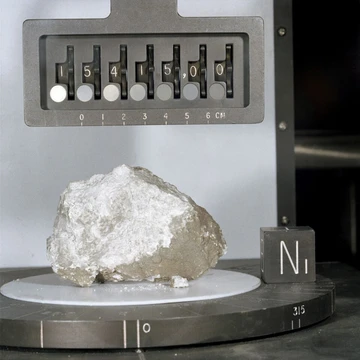
Lunar rock samples have been brought back by both robotic and crewed missions. Robotic spacecraft have also returned samples from comet Wild 2 and the asteroids 25143 Itokawa, 162173 Ryugu, and 101955 Bennu. The robotic Genesis mission returned samples of the solar wind. Additionally, samples from three non-terrestrial bodies have reached Earth through other means: lunar meteorites from the Moon, Martian meteorites from Mars, and HED meteorites from the asteroid Vesta.
Having samples on Earth allows scientists to use far more advanced and diverse laboratory tools than those that can be carried on a spacecraft. These tools can distinguish extraterrestrial material from terrestrial contamination and can be used to follow up on any findings, including with instruments developed after a mission launches. In contrast, a spacecraft carries only a limited set of analytic tools, chosen and built years before launch. Samples analyzed on Earth can also be compared with remote sensing data to better understand the processes that formed the Solar System. For example, HED meteorites were matched with data from the Dawn spacecraft at Vesta, revealing that the meteorites came from the Rheasilvia impact crater and helping to deduce the composition of Vesta’s crust, mantle, and core. While imaging alone can reveal some differences in asteroid and comet compositions, future sample returns will provide a more precise inventory to match against telescope and spectroscopic data.
Another key focus is searching for the building blocks of life on comets, asteroids, Mars, and the moons of gas giants. Several sample-return missions to asteroids and comets are underway, aiming to determine whether life formed in space and was carried to Earth by meteorites. Other questions include whether extraterrestrial life formed on Mars or the moons of gas giants, and whether it might still exist there. NASA’s last
- first_samples_from_beyond_lunar_orbit
- Stardust (comet Wild 2, 2006) – first samples from a distinct celestial body beyond the Moon; Genesis collected solar wind at L1, which is beyond lunar orbit but not from a distinct body.
Lore & Background
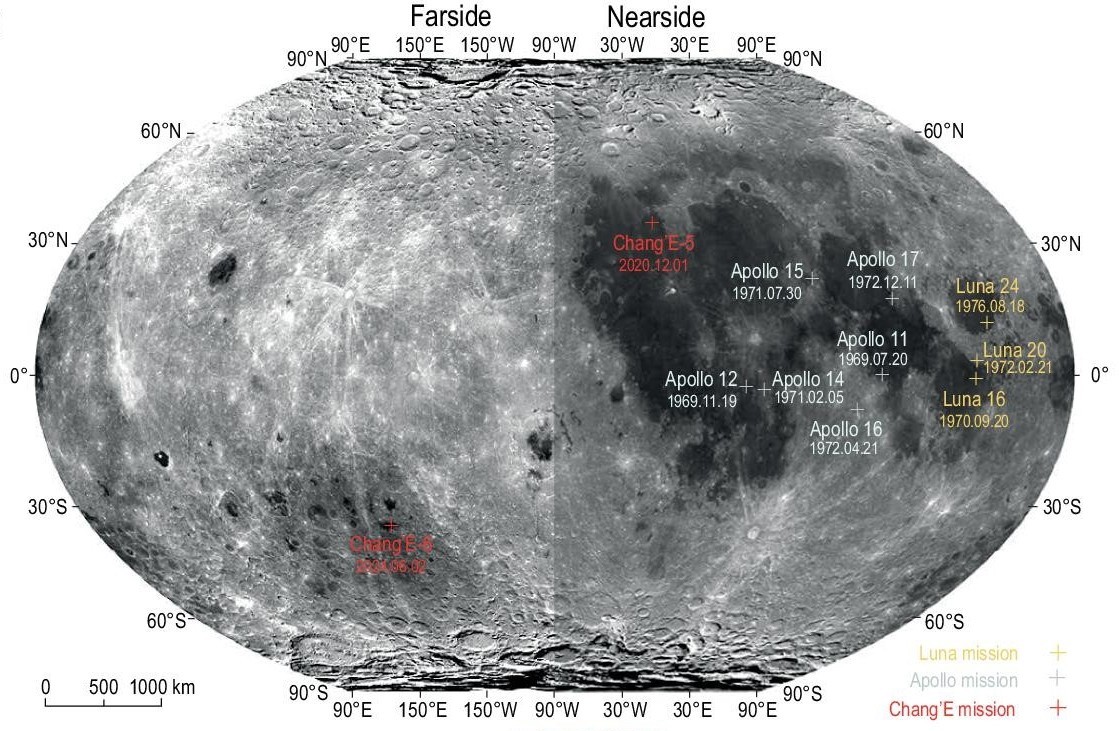
The first successful sample return from another Solar System body was achieved by Apollo 11 in July 1969, returning 22 kilograms of lunar surface material. This was followed by additional Apollo missions that collectively returned over 382 kg of lunar rocks and regolith. The robotic Soviet Luna program also returned lunar samples: Luna 16 returned 101 grams in 1970, Luna 20 returned 55 grams in 1972, and Luna 24 returned 170 grams in 1976. Several other Luna attempts failed due to launch or landing issues.
In the 2000s, the Genesis mission returned solar wind samples from beyond Earth orbit in 2004, though its capsule crash-landed in Utah. Scientists managed to save many samples. NASA's Stardust spac
Reader's Guide
Sample-return missions are significant because they allow Earth-based laboratories to analyze extraterrestrial material with far more advanced and diverse tools than can be carried on spacecraft. This enables follow-up analysis with different instruments, including those that can distinguish intrinsic extraterrestrial material from terrestrial contamination, and tools not yet developed. Samples analyzed on Earth can be matched against remote sensing data to provide deeper insight into Solar System formation, as was done with HED meteorites and Dawn spacecraft data from Vesta.
Planetary protection is a key concern for sample-return missions, especially those from locations with potential to host life. Such missions are classified as category V under COSPAR, requiring containment of unsterilized samples. Carl Sagan and Joshua Lederberg argued in the 1970s for extreme caution, and later studies by the NRC and ESF agreed. The search for building blocks of life and possible extraterrestrial life on Mars, comets, and asteroids drives ongoing and future sample-return missions.
Did You Know?
- The Apollo program returned over 382 kg of lunar rocks and regolith, with 75% stored at the Lunar Sample Laboratory Facility built in 1979.
- The Genesis mission's capsule crash-landed in the Utah desert, but scientists managed to save many of the solar wind samples.
- Stardust used a collector array made of low-density aerogel (99% space) to collect cometary particles without damaging them.
- Samples from three non-terrestrial bodies have been collected by other means: Lunar meteorites, Martian meteorites, and HED meteorites from Vesta.
Scientific Rationale and the Case for Returned Material
The core argument for bringing Martian material back to Earth rests on the depth of analysis possible in terrestrial laboratories. Thomas Zurbuchen, NASA's associate administrator for science, has expressed confidence that returned specimens will yield discoveries spanning multiple scientific disciplines. Crucially, samples preserved on Earth can be re-examined decades later with instruments that have not yet been invented, giving the mission a longevity far beyond any single rover campaign. In 2006, the Mars Exploration Program Analysis Group catalogued fifty-five key investigations tied to Mars exploration. By 2008, that group determined roughly half of those investigations could be advanced, at least partially, through sample return, calling MSR the single mission capable of making the greatest overall progress across the entire list. A significant portion of those studies, they noted, could not move forward meaningfully without physical material in hand. Even before dedicated missions, scientists have relied on Martian meteorites—rocks blasted off the planet by ancient impacts that eventually landed on Earth. As of August 2023, three hundred fifty-six such meteorites had been confirmed among more than seventy-nine thousand known specimens, identified through matching elemental and isotopic signatures with data gathered on Mars itself.
Early Concepts and Decades of Engineering Pioneering
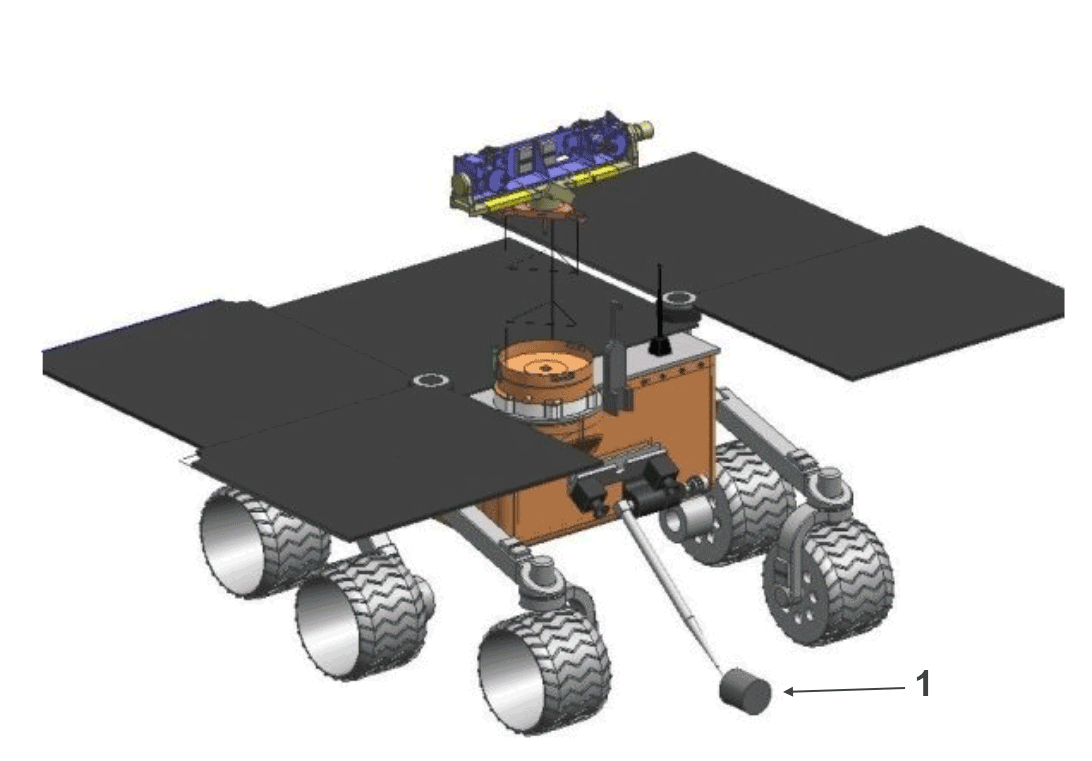
The idea of hauling rock and dust back from Mars surfaced in technical literature even before the first spacecraft flew past the red planet, during the Apollo development era. Early engineers at Lockheed had to model trajectory options across a wide range of aerodynamic drag conditions because the density of the Martian atmosphere was still unknown. In the early 1970s, while Viking was being developed, NASA's Langley Research Center and JPL jointly studied surface-to-orbit launch vehicles, noting that the mass of such a vehicle would ripple through every earlier phase of the mission. The Soviet Union attempted its own path: Mars 5NM was planned for 1975 but cancelled after repeated N1 rocket failures, and a follow-up, Mars 5M, was scrapped in 1979 over complexity and technical difficulties. A more unconventional early concept, SCIM, proposed sending a spacecraft on a grazing pass through Mars's upper atmosphere to scoop dust and air without ever landing. By the mid-1980s, JPL planners acknowledged that budgetary pressures had pushed MSR into the 1990s and that the round trip imposed demanding propulsion requirements, sketching notional mass budgets involving multi-ton ascent vehicles and twenty-kilogram sample canisters holding five kilograms of drilled cores.
The ALH84001 Spark and the Propulsion Mass Problem
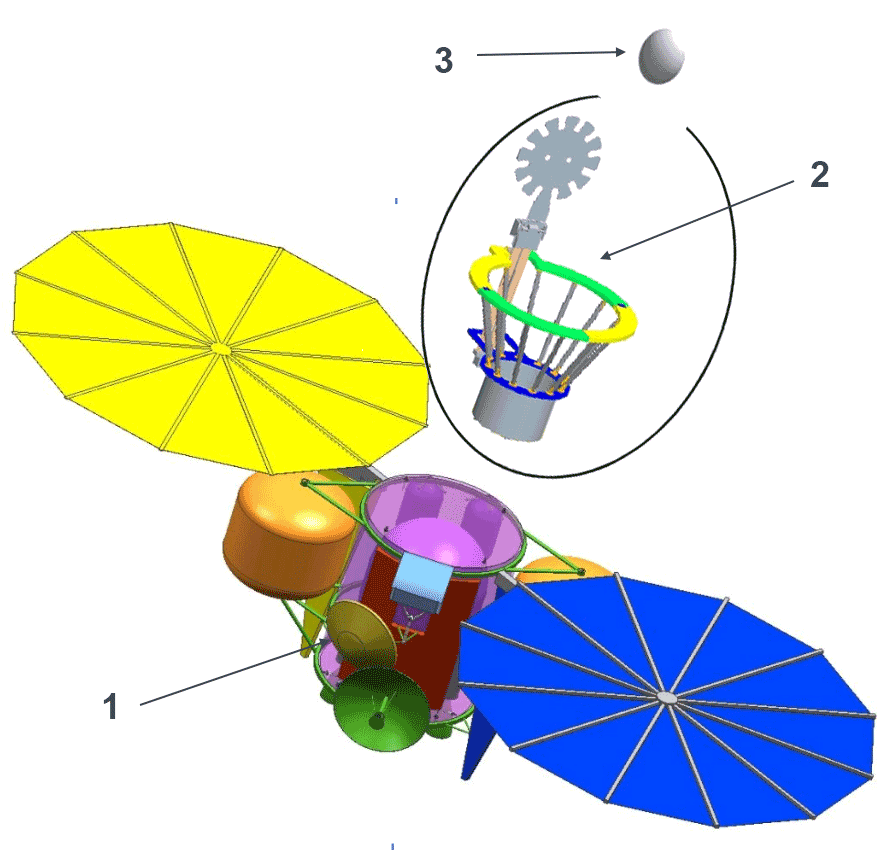
A pivotal moment arrived in 1996, when researchers reported apparent microfossils in the Martian meteorite ALH84001. Although that hypothesis was ultimately rejected, it ignited a wave of renewed public and scientific interest in bringing Mars material home. Around the same time, NASA funded JPL and Lockheed Martin to explore affordable small-scale architectures, including a concept to return just five hundred grams of samples using a hundred-kilogram Mars ascent vehicle meeting a small orbiter. Robert Zubrin, a prominent advocate for human Mars exploration, argued in 1996 that the most efficient strategy would be a direct return to Earth using propellants manufactured on Mars, estimating a fully fueled ascent vehicle at five hundred kilograms—too heavy to ship from Earth economically. International peer reviewers agreed with his assessment. Yet a 1997 detailed analysis of both solid and liquid propulsion components concluded that existing hardware was simply too heavy to build an ascent vehicle in the several-hundred-kilogram range, and recommended applying launch-vehicle design principles to develop entirely new tiny-scale hardware. This propulsion mass problem became one of the central engineering obstacles defining the field for years to come.
The Shifting Global Mission Landscape of the 2020s
As of 2026, the global landscape for Mars sample return is in flux. China's National Space Administration has a robotic dual-launch mission, Tianwen-3, targeting the December 2028 to January 2029 Mars launch window. Russia's Roscosmos has outlined plans for Mars-Grunt in the 2030s, while Japan's JAXA is pursuing a different but related goal with the Martian Moons eXploration, or MMX, proposal, which aims to return samples from Phobos rather than the Martian surface itself. The most high-profile Western effort, the joint NASA-ESA Mars Sample Return mission, was approved in 2022 to retrieve samples gathered by the Perseverance rover, yet it was cancelled in 2026. Concerns about back contamination—introducing unknown Martian biology into Earth's biosphere—have been raised, though the risk is generally assessed as low. The cancellation of the flagship Western program underscores how politically and financially fragile these multi-decade endeavors remain, even as the scientific case for them grows stronger and more nations press forward with their own timelines.
Gallery
Frequently Asked Questions
What exactly is a sample-return mission?
It is a spacecraft voyage to a body outside Earth—such as the Moon, an asteroid, or a comet—whose goal is to collect physical material (ranging from single atoms to chunks of rock) and deliver it back to our planet for laboratory analysis. Collection techniques can involve scooping soil, drilling into rock, or deploying particle-trapping arrays for solar-wind and cometary debris.
Which mission was the first to successfully bring extraterrestrial samples home?
Apollo 11, in July 1969, holds that distinction as the first crewed flight to return lunar material to Earth. Across the entire Apollo program, astronauts brought back more than 382 kilograms of Moon rock and regolith.
What was the first robotic spacecraft to return lunar samples?
The Soviet Luna 16 probe, which landed on the Moon in 1970, was the first uncrewed vehicle to collect and return lunar soil to Earth. It demonstrated that automated sample-return was feasible without a human crew.
When did humanity first retrieve samples from beyond the Moon's orbit?
NASA's Genesis mission, which completed its sample return in 2004, collected solar-wind particles in interplanetary space, marking the first material gathered from outside lunar orbit. That milestone was followed by Stardust's 2006 return of comet dust and Hayabusa's 2010 delivery of asteroid regolith.
Why do scientists worry about bringing alien samples back to Earth?
There is a legitimate concern that extraterrestrial material could carry organisms or chemical agents unknown to terrestrial ecosystems, posing a potential biohazard. Because of this, returned samples are handled in dedicated containment facilities before any open-laboratory study begins.
More in Sample return missions 1-24
Spotted an error? Know more?
This is a living reference — every entry is fact-audited, and reader corrections feed straight into our audit queue. Suggest an edit · See this site's audit record