CAESAR (spacecraft)
Proposed comet sample-return mission to 67P, not selected.
CAESAR (Comet Astrobiology Exploration Sample Return) was a sample-return mission concept to comet 67P/Churyumov–Gerasimenko, proposed in 2017 to NASA's New Frontiers program mission 4. It was one of two finalists selected for further concept development on 20 December 2017, but the other finalist, Dragonfly, was chosen instead on 27 June 2019.
- Principal Investigator
- Steve Squyres
Lore & Background
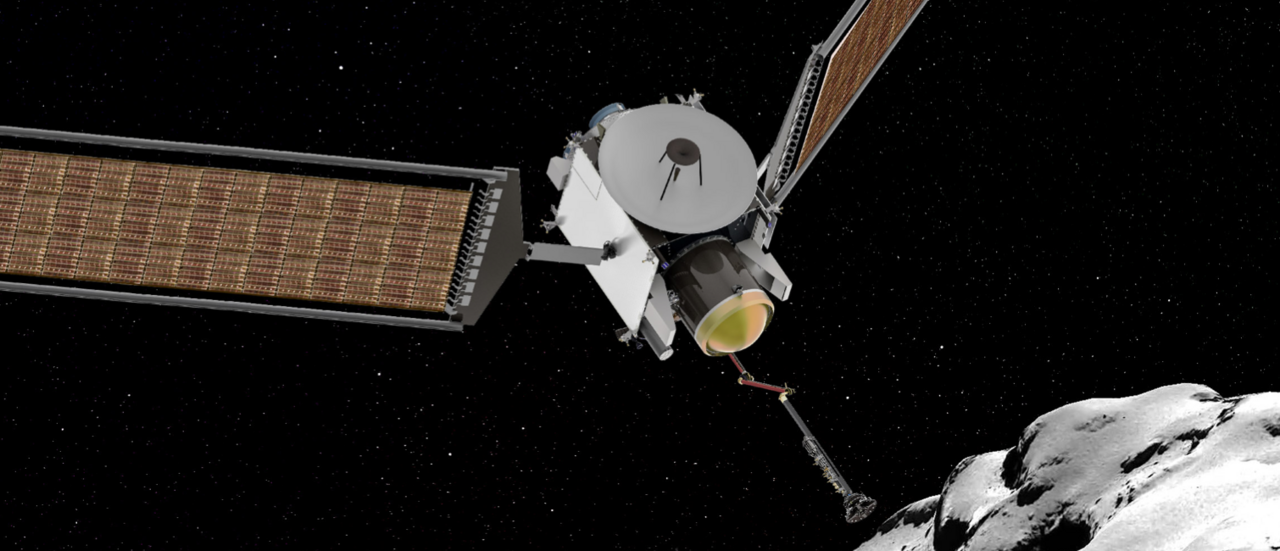
CAESAR was designed to collect and return a sample from comet 67P, leveraging data from the Rosetta mission (2014–2016) to increase mission success chances. The spacecraft would use a touch-and-go robotic arm, similar to OSIRIS-REx, to collect at least 80 grams of regolith (with a capability to collect up to 800 grams), including pebbles up to 4.5 cm. Volatiles and solids would be separated and kept cold for the return trip, with a capsule provided by JAXA based on Hayabusa2 designs.
The propulsion system would use NASA's Evolutionary Xenon Thruster (NEXT), a solar electric propulsion type, with one primary thruster and one redundant unit. The spacecraft would launch between 2024 and 2025 if selected, returning a sample to Earth in 2038. Curation would be handled by JAXA, which would manage the capsule and allocate samples, with a portion curated at Japan's Extraterrestrial Sample Curation Center and the rest distributed to international partners.
Reader's Guide
CAESAR was a significant concept because it aimed to return a pristine sample from a comet whose geology was already well understood from the Rosetta mission, potentially revealing organic compounds (tholins) that may have seeded Earth with life's raw materials. Although not selected, it represented a mature design that built on prior missions like Stardust and OSIRIS-REx, and it highlighted the continued scientific interest in cometary sample return as a priority in planetary science decadal surveys. The mission's detailed planning—including a robotic arm, nitrogen-gas sampling, and cold storage—demonstrated how existing technology could be adapted for cometary environments. Its legacy includes advancing the technical readiness for future comet sample-return missions and underscoring the competitive nature of NASA's New Frontiers program.
Did You Know?
- CAESAR was one of two finalists for NASA's New Frontiers mission 4, announced on 20 December 2017.
- The spacecraft would have used a touch-and-go robotic arm to collect at least 80 grams of regolith from comet 67P, with a capability to collect up to 800 grams.
- The sample return capsule was provided by JAXA, based on the Hayabusa2 designs, and JAXA would handle curation and sample allocation.
- Tholins, detected by Rosetta at comet 67P, were a key astrobiology target for CAESAR.
The Road to New Frontiers
CAESAR emerged from a long-standing desire within the planetary science community to bring back physical material from a comet. Both the 2003 and 2011 Planetary Science Decadal Surveys had listed a comet sample-return effort among their recommended priorities for NASA, signaling that the idea had been percolating for well over a decade. An earlier attempt, the Comet Hopper proposal, earned three million dollars in concept-study funding as a Discovery Program finalist in 2011 but was not ultimately selected. NASA's broader track record with comets—missions including Deep Space 1, Stardust, CONTOUR, and Deep Impact—provided a foundation of operational experience. When NASA opened its New Frontiers Mission 4 solicitation, the CAESAR team, led by Principal Investigator Alexander Hayes of Cornell University, pitched a sample-return campaign targeting 67P/Churyumov–Gerasimenko. On 20 December 2017, the proposal was named one of just two finalists alongside Dragonfly to Titan. Each finalist received four million dollars to mature its concept through the end of 2018. On 27 June 2019, NASA chose Dragonfly, ending CAESAR's bid for a flight mission.
Chasing the Seeds of Life
The scientific heart of CAESAR lay in astrobiology and the question of how the ingredients for life arrived on Earth. Researchers have long hypothesized that organic compounds, particularly tholins—complex molecules formed when simple gases are irradiated—may have been delivered to the early planet by cometary impacts, providing the raw chemical building blocks from which life could eventually emerge. The European Space Agency's Rosetta mission, which orbited 67P from 2014 to 2016, confirmed the presence of tholins on that comet's surface, lending credibility to the seeding hypothesis. CAESAR's objectives extended beyond mere detection: the mission aimed to understand how the Solar System's primordial materials assembled into planets and ultimately gave rise to biology. By returning a physical sample to Earth laboratories, scientists could perform analyses far more detailed than any in-situ instrument allows, tracing the molecular fingerprints of early solar nebula chemistry and testing whether cometary organics truly match the kinds found in terrestrial prebiotic environments.
Engineering a Comet Visitor
The spacecraft architecture for CAESAR drew on a constellation of proven technologies and international partnerships. Northrop Grumman Innovation Systems was selected as the prime builder, and the design inherited heritage from the successful Dawn mission. Propulsion would rely on NASA's Evolutionary Xenon Thruster, a solar-electric system using xenon gas; three thrusters were planned, with one serving as a spare. The camera suite, supplied by Malin Space Science Systems, comprised six instruments spanning different fields of view and focal ranges: a narrow-angle camera, a medium-angle camera, a touch-and-go camera, two navigation cameras, and a dedicated sample-container camera. Honeybee Robotics provided the Touch-And-Go robotic arm and the Sample Acquisition System. The sample-return capsule and its heatshield were contributed by Japan's JAXA, building on the design heritage of the Hayabusa and Hayabusa2 missions. NASA's Goddard Space Flight Center in Greenbelt, Maryland, would manage the overall mission.
Touch, Collect, and Come Home
Rather than landing, CAESAR would make a brief, controlled contact with the comet's surface using its Touch-And-Go arm, a technique analogous to what OSIRIS-REx performed at asteroid Bennu. During that moment, the spacecraft would raise its solar arrays into a Y-shaped configuration to keep them clear of dust and provide additional ground clearance. The sampling mechanism would fire a burst of compressed nitrogen gas to loft regolith particles into a collection head at the arm's tip. The system carried enough nitrogen for up to three sampling events and was designed to gather between 80 and 800 grams of material, with pebbles up to 4.5 centimeters in diameter. A critical step in the return journey involved separating volatile and solid components into distinct containers and keeping the samples cold throughout the transit home. The JAXA-built capsule would re-enter Earth's atmosphere in 2038 and parachute down at the Utah Test and Training Range. At Johnson Space Center's ARES laboratory, at least 75 percent of the sample would be preserved for future generations of researchers, with a smaller portion also curated at Japan's Extraterrestrial Sample Curation Center.
Gallery
Frequently Asked Questions
What is CAESAR (spacecraft)?
CAESAR, short for Comet Astrobiology Exploration Sample Return, was a proposed NASA sample-return mission concept designed to collect material from a comet and bring it back to Earth. It was developed under NASA's New Frontiers program as a candidate for the fourth mission slot.
What was CAESAR's target and primary objective?
The mission aimed to fly to comet 67P/Churyumov–Gerasimenko and retrieve a physical sample of its surface material for laboratory analysis on Earth. The goal was to study the comet's composition to gain insights into early solar-system chemistry and astrobiology.
Who led the CAESAR concept and which center managed it?
Alexander Hayes served as the Principal Investigator for the proposal, and NASA Goddard Space Flight Center acted as the managing center for the concept development work.
Was CAESAR selected for flight?
No. CAESAR was one of two finalists named on 20 December 2017, but in June 2019 NASA chose the competing Dragonfly concept for New Frontiers mission 4, leaving CAESAR as an unselected proposal.
Why do fans of sample-return missions still talk about CAESAR?
It represents a serious, well-studied attempt to extend sample-return science beyond Mars and the inner planets to a small, volatile-rich body in the outer solar system. Its loss to Dragonfly is often cited as a reminder of how few mission slots exist and how hard it is to get a comet sample back to Earth.
More in Sample return missions 1-24
Spotted an error? Know more?
This is a living reference — every entry is fact-audited, and reader corrections feed straight into our audit queue. Suggest an edit · See this site's audit record